
Here's what it actually is, why it matters, and how to apply it inside a real business — not a productivity blog fantasy.
What Is the Eisenhower Matrix?
The framework is named after Dwight D. Eisenhower — five-star general, Supreme Allied Commander of the Allied Expeditionary Force in World War II, and the 34th President of the United States. Eisenhower was known for sustaining extraordinary output across extraordinarily high-stakes environments.
"What is important is seldom urgent, and what is urgent is seldom important." — Dwight D. Eisenhower
This insight — later formalized by Stephen Covey in The 7 Habits of Highly Effective People as the Time Management Matrix — became the foundation of what is now one of the most practical decision-making tools in business.
The premise is simple. Every task you face sits somewhere on two axes:
- Urgency — Does this have a hard deadline or immediate consequence?
- Importance — Does this directly serve your goals, your mission, or the people depending on you?
Plot those two variables and you get four quadrants — each with a specific, non-negotiable response.
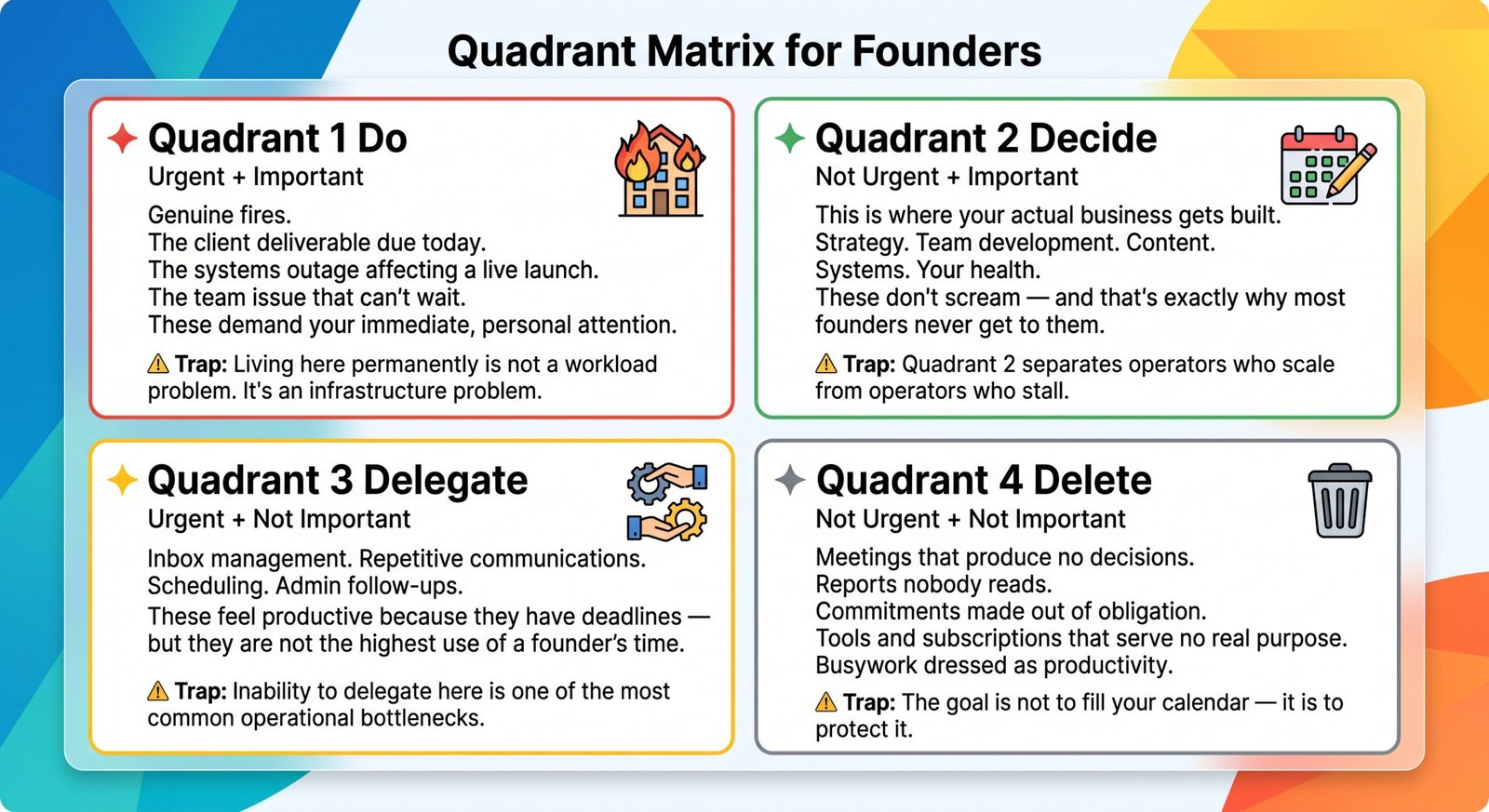
Why Most People Get This Wrong
The Eisenhower Matrix is simple to understand and difficult to execute — for one specific reason: urgency feels productive. Importance rarely does.
When you are answering messages quickly, clearing notifications, putting out fires, and moving through your to-do list — your brain registers this as progress. There is a physiological reward in completion, in responsiveness, in visible forward motion.
But building a referral system? Developing a team member's skills? Reworking your onboarding to reduce client churn? These activities produce results that are invisible for weeks or months. They require sustained attention on things that will not remind you they exist.
A study published in the Journal of Consumer Research found that people systematically prefer urgent tasks over important ones — even when they acknowledge intellectually that the important tasks are more valuable. Researchers called this the "mere urgency effect." It is operating inside your business right now, whether you recognize it or not.
This is why Quadrant 2 — the most important quadrant for long-term growth — is consistently the most neglected. And it's why the founders who protect it are the ones who scale without chaos.
What This Looks Like Inside a Real Business
The matrix is not a theoretical tool. It is a practical filter — and applying it changes how you design your week, structure your team, and make decisions about growth.
For Coaches & Trainers
Your coaching hours should be non-negotiable blocks. The moment logistics start bleeding into delivery time, you've lost the distinction.
Intake forms, scheduling, automated follow-ups, client portals — every hour you spend managing these manually is an hour a properly built system should handle. That's an operational gap, not a time management issue.
Refining your framework, building your next program, strengthening your referral system — these never scream. Schedule them or they won't happen.
For Scaling Agencies
SOPs, process guides, team onboarding materials — consistently deprioritized because they are not urgent. Until someone leaves. Until a mistake repeats. Until a client escalation exposes a gap that's existed for two years.
If your senior team members are handling routine client communications, you have a delegation architecture problem. That's fixable — but only if you treat it as Quadrant 2 work first.
Those that don't are constantly rebuilding from Quadrant 1. The infrastructure gap compounds over time — and it always surfaces at the worst possible moment.
How to Apply It: A Practical Starting Point
You do not need a new tool, a new app, or a two-day offsite to start using this framework. You need a list and honest answers to two questions.
- Write down every task currently on your plate — active projects, recurring responsibilities, and the things that have been sitting on your list for three weeks.
- For each item, ask: Is this urgent? Is this important? Answer both, separately.
- Assign each task to a quadrant. Be honest. Urgency is not the same as importance, no matter how much it feels that way in the moment.
- Before you open your inbox tomorrow morning, identify one Quadrant 2 item and block a protected hour for it. Not at the end of the day. Not "if I have time." First.
That single habit, practiced consistently, is where operational clarity begins.
The Deeper Point
The Eisenhower Matrix is not a time management hack. It is a decision-making discipline.
What it forces is a confrontation with the difference between reacting to your business and building your business — and most founders, especially in the early and middle stages of growth, are doing far more of the former than they realize.
The founders, coaches, and agency owners who scale sustainably are not the ones who work the most hours. They are the ones who have the clearest picture of what actually deserves their attention — and the operational infrastructure to ensure everything else gets handled without them.
That infrastructure does not build itself. And clarity does not come from moving faster.
It comes from deciding better.
Here's what I've actually seen inside real businesses.
Most founders do not have a task management problem. They have a decision avoidance problem dressed up as busyness.
The reason Quadrant 2 never gets done is not because there isn't time. It's because Quadrant 2 requires you to sit with something uncomfortable — the systems you haven't built, the team you haven't developed, the processes you haven't documented — and do the slow, quiet work of building infrastructure that won't show results until next quarter.
That is harder than answering emails. It requires a different kind of discipline.
I run a remote-first operational team. I support businesses that are in growth mode. And the one pattern that predicts whether a business will hit the ceiling in the next 12 months — more than niche, more than offer, more than audience size — is whether the founder has learned to protect Quadrant 2.
If your week is back-to-back urgency, the problem is not your calendar. The problem is what's missing underneath it.
Build the foundation. The rest gets easier from there.